
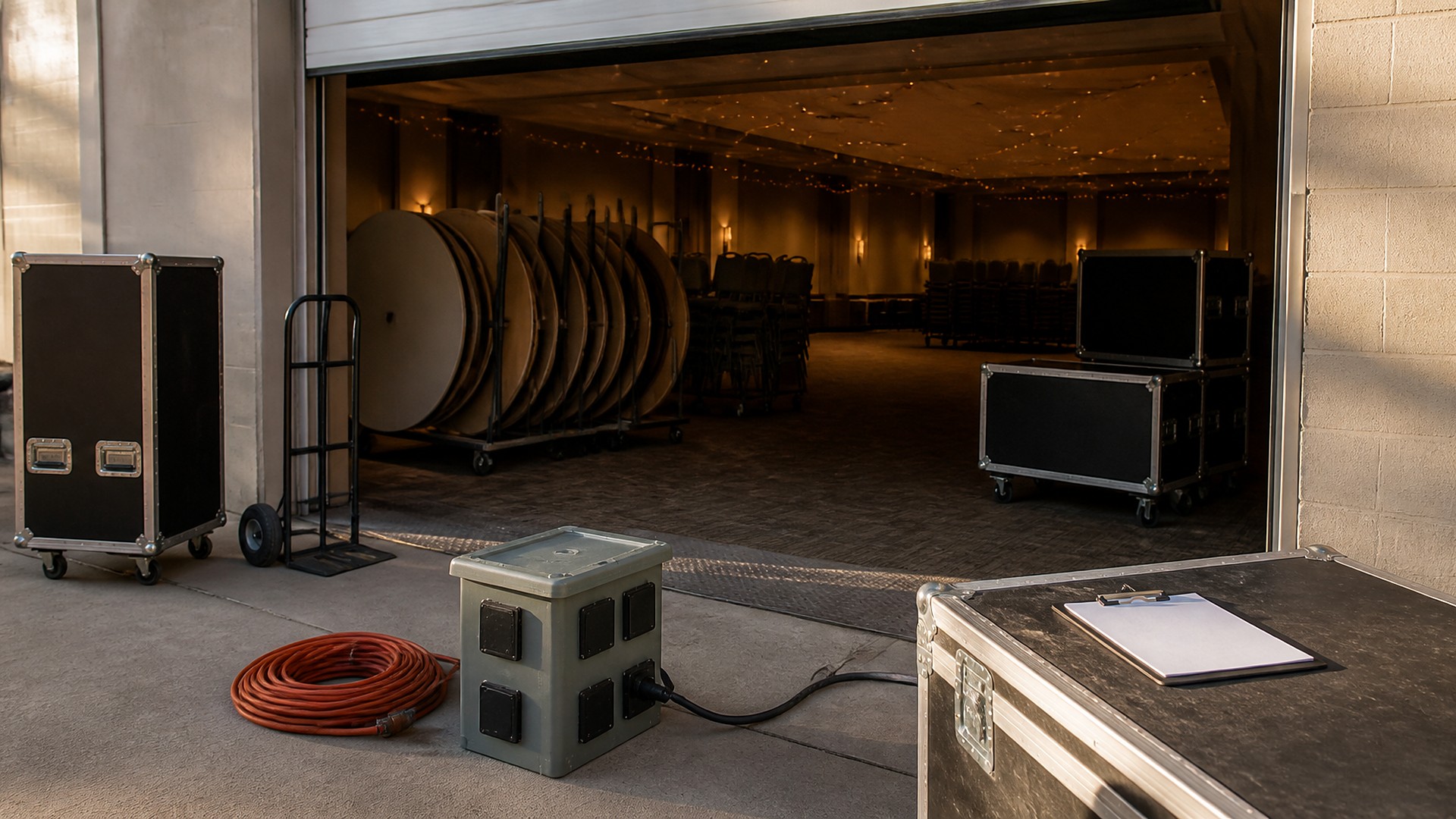
Why vendor logistics arrive too late
Picture a Saturday reception at a banquet hall. The band arrives with a truck and asks where the dedicated circuit is. The caterer needs two more outlets for warming equipment than anyone planned. The photo booth vendor shows up during the florist's load-in slot, and both trucks wait at the same door. Each vendor did mention these needs at some point, in an email, a phone call, or a contract attachment. Nobody put them in one place before the day. That scene is an illustration, not a TwoQM client.
Most day-of chaos at the dock starts weeks earlier, when vendor logistics are collected loosely or not at all. The fix is a short, consistent logistics request each vendor answers before the event, and a person who reviews the answers against the venue's rules.
This is an operations article, not electrical, fire, or safety advice. The venue's rules, a licensed electrician, and the local fire marshal decide what power, cabling, and equipment are allowed and safe. This piece is about how a planner or venue collects and reviews vendor needs so those people get accurate information early.
TwoQM has already written about day-of run-of-show checklists shared with vendors and about hold, tentative, and confirmed date boards for event venues. This piece is different: gathering each vendor's arrival window, vehicle, and power needs before the run-of-show is final, so the timeline is built on facts instead of guesses.
Here is an original example, not a measured result. Planners and venues that collect logistics informally tend to hit the same problems:
Answers are scattered. One vendor's power needs are in a contract, another's are in a text thread.
Questions differ every time. Each planner asks something slightly different, so some vendors never say how big their vehicle is.
Power is described vaguely. "We just need a couple of outlets" does not tell the venue what equipment will be plugged in.
Load-in windows overlap. Two vendors are told "come in the afternoon" and both use the same door.
Venue rules arrive last. A vendor learns about dock height, elevator limits, or open-flame rules at the door.
Bilingual crews get one version. Instructions go out only in English, even when a crew lead prefers Spanish.
One logistics request for every vendor
Send every booked vendor the same short request, in their preferred language, with the venue's rules attached. Ask for:
Arrival and load-out windows requested, plus how long setup and teardown take.
Vehicle type and size, and whether it needs to stay at the dock or can move to parking.
Crew lead on site with a mobile number and preferred language.
Equipment that needs power, listed item by item, with the amperage or wattage from each manufacturer label when the vendor knows it.
Other needs, such as water, a table near an outlet, elevator use, or cable runs across walkways.
Acknowledgment of venue rules, including any items the venue does not allow.
Set a cutoff date that works for your events, and track who has answered, who has not, and who answered with something incomplete.
Review before the run-of-show is final
Answers go to a review list, not straight onto the timeline. The planner assigns each vendor a load-in window and door so arrivals do not stack up. The venue coordinator reviews power and equipment needs against the room's available circuits and house rules, and sends anything unusual to the venue's electrician or the fire marshal as the venue requires. Only reviewed, confirmed windows and power assignments flow into the run-of-show, and each vendor gets a confirmation of their own window, door, and power location.
If a vendor changes their equipment list later, the change goes back through review instead of quietly replacing the old answer.
Where TwoQM fits
Ordinary business automation can send the logistics request when a vendor is booked, chase missing answers, flag overlapping load-in requests, and send each vendor their confirmed window. Connected systems can pull booked vendors from the planner's CRM or event records and push confirmed windows into the run-of-show. When a venue needs its own review screens for rooms, doors, and circuits, custom software can build them around how that venue works.
Where AI helps, and where it stops
AI can turn a vendor's free-text answer into a clean equipment list for review, flag answers that leave out power details, and draft the request and confirmations in English and Spanish for the planner to check. AI does not decide what load a circuit can handle, does not approve equipment, and does not assign windows on its own. A person reviews every answer and approves every confirmation before it goes out.
Where to start this week
Take your next event and write the logistics request you wish every vendor had answered. Send it to two or three booked vendors and see which questions come back incomplete. Then ask your venue contact which power and equipment details they need from vendors in advance.
TwoQM builds automation, connected systems, and custom software for event teams, caterers, and restaurants that host events. If vendor logistics still arrive at the dock on the day, TwoQM can scope a logistics request and review workflow around the tools you already use. Pricing explains how business apps, systems, and custom software are scoped.
Describe Your Vendor Logistics Workflow · Explore TwoQM business automation