
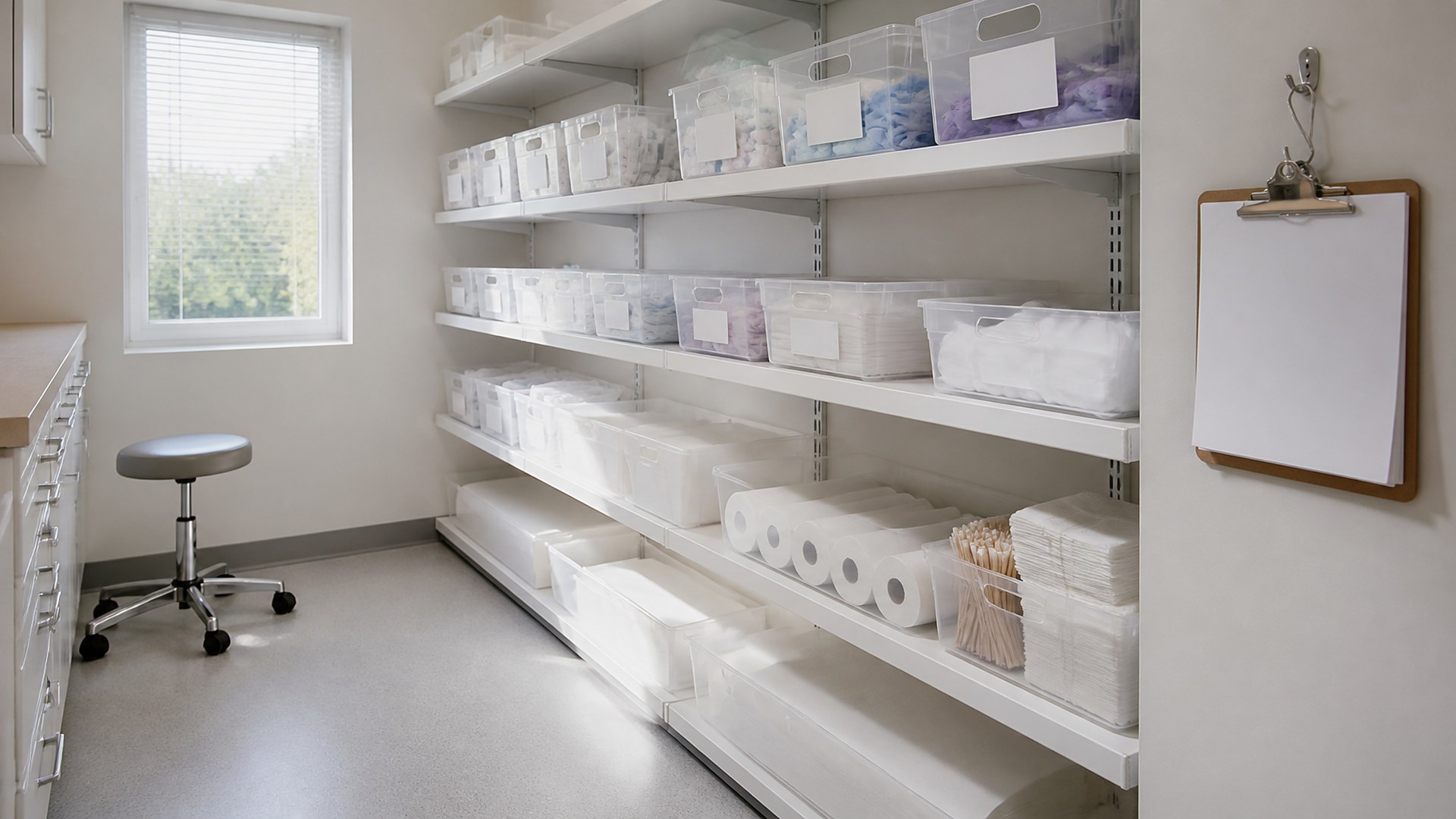
Set a par level for each room and each closet
Picture a small medical office on a Monday morning. The first patient is in Room 2 and the medical assistant reaches for exam table paper. The shelf is empty. The back supply closet has three boxes of the wrong glove size and none of the right one. Someone placed an order on Thursday, but nobody knows what was on it. The office manager keeps a reorder list in a notebook, a provider texted a request on Friday, and the front desk ordered "a few things" from a different supplier last week.
That scene is an original illustration, not a TwoQM client and not a measured result. It describes a common gap: offices run scheduling and referrals through careful systems, while everyday non-clinical supplies are restocked by memory and hallway requests.
This article is about par levels and weekly restock requests for everyday exam room and front-office supplies: gloves, table paper, gauze, cotton swabs, sanitizer, printer paper, and similar items. It is not about medications, vaccines, controlled substances, lot tracking, or anything that falls under clinical or regulatory inventory rules. Those need their own processes and advice from your compliance and clinical leads.
A par level is the amount of an item that should be on hand in a specific place when it is fully stocked. Start small:
List the locations: each exam room, the procedure room if you have one, the front desk, and the main supply closet.
List the items each location actually uses: keep it to the everyday items people reach for, not every item the office has ever bought.
Set a par and a reorder point: for example, "Room 2: table paper, par 3 rolls, restock at 1." The numbers are yours to choose based on how busy each room is.
Name the unit: box, roll, pack, or case, so nobody counts "two" when one means two boxes and the other means two cases.
Write the par sheet once, keep it with the restock system, and change it when a room's use changes, not every time someone feels a shelf looks low.
A weekly restock request, not a running text thread
Once par levels exist, restocking becomes a short routine instead of a scramble:
On a set day, one person walks the rooms and closet, records what is below the reorder point, and submits one restock request.
Requests from providers or staff during the week go into the same request form, not into texts or sticky notes.
Each request line shows the item, location, quantity needed, and who requested it.
The office manager reviews and approves the request before anything is ordered, and the approved order is attached to the request.
When the delivery arrives, the person receiving it checks it against the approved request and marks what is short or backordered.
Bilingual labels help when your staff works in English and Spanish. Keep one item list underneath and show both names on the same row, such as "Exam table paper / Papel para camilla," so the count does not depend on who is on shift.
If your office already tracks referrals between offices and admin staff, keep supplies in a separate lane. The same goes for no-show policy notices: one system answers "who is coming in," the other answers "is the room ready." Other service businesses face a similar inventory problem; spas, for example, tie retail product inventory to service tickets, and retailers run cycle counts without halting the register.
What the office manager reviews each month
With requests and receipts in one place, a short monthly review becomes possible:
Which items fall below par most often, and in which rooms?
Which par levels are set too high, leaving boxes to expire or take up space?
How often did a request come in outside the weekly routine because something ran out?
Which items are often backordered, and is there a second approved source?
These questions help you adjust par levels and ordering habits. They are not clinical decisions, and they do not replace your supplier agreements or purchasing policies.
Where TwoQM fits
Many practice management systems handle appointments and billing but do not cover the supply closet. Business automation can turn the weekly walk-through into a simple form, flag items below their reorder point, route the request to the office manager for approval, and remind the receiver to check deliveries against it. Connected systems can link the approved request to your accounting or purchasing tool so nobody retypes it. What fits your office is confirmed during scoping. See how TwoQM supports medical practices.
Where AI helps, and where it stops
AI can draft a short monthly summary of which items ran low most often and which par levels might need a second look.
AI does not place orders, approve spending, change par levels, or make any decision about clinical supplies or patient care. A person on your team does.
Where to start this week
Pick one exam room and the main supply closet. Write a par sheet for the ten items your staff reaches for most. For the next two weeks, collect every restock request for those locations through one form, with the office manager approving before anything is ordered. Then look at what ran out and what sat on the shelf.
TwoQM builds custom software, automation, and connected systems for small businesses in the Rio Grande Valley and beyond. This article describes operational workflows for everyday non-clinical supplies; it is not medical, compliance, or regulatory advice. Ask your clinical and compliance leads which supplies need stricter handling. Pricing explains how business apps, systems, and custom software are scoped.
Describe Your Supply Restock Workflow · Explore TwoQM Business Automation